
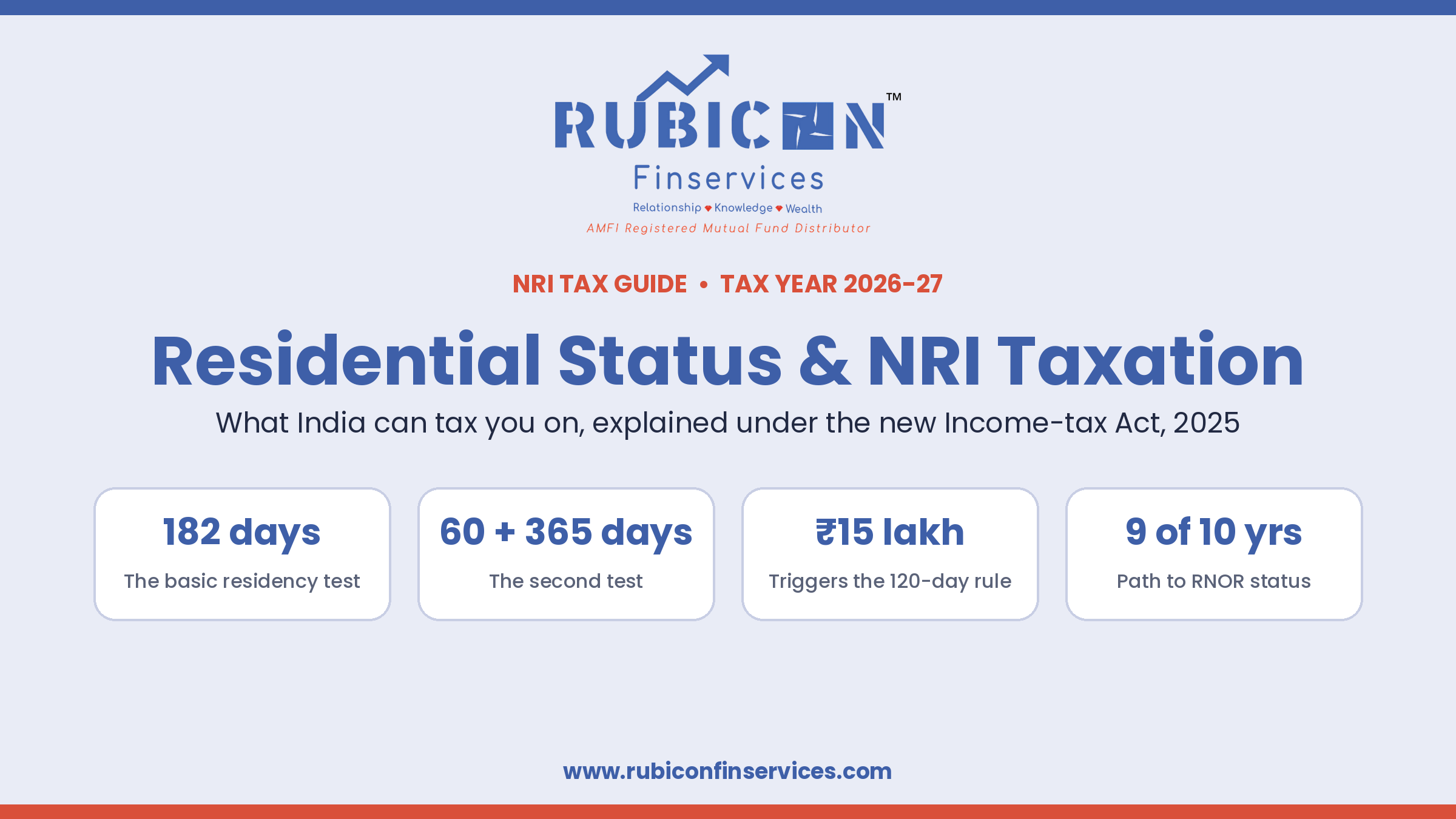
Your tax residency, not your passport, decides what India can tax. This guide explains the day-count tests under Section 6 of the new Income-tax Act, 2025, the difference between ROR, RNOR and NRI, how common NRI income such as mutual fund gains, property sales and bank interest is taxed, and how returning Indians can use the RNOR window.
In a recent meeting with one of my NRI clients, we happened to get talking about tax residency and tax status: what exactly decides whether someone is a resident or a non-resident for tax, and how that changes what they pay in India. It wasn't on the agenda, but we ended up spending a good part of the meeting on it, and it struck me that many of my other NRI clients, and families with children or siblings living abroad, are probably asking themselves the same thing. So I thought it would be useful to cover the topic in detail here.
The short answer is that it depends, and not on the passport or the visa. For income tax, what matters is your residential status for the year, and that is worked out almost entirely by counting the days you spend in India. Get it right, and an NRI pays Indian tax only on Indian income. Get it wrong, and you can end up with Indian tax on your salary abroad, or a notice asking why you didn't report foreign assets.
This guide walks through how residential status is decided, what each status means for your tax bill, and how common NRI income is taxed today.
First, what changed on 1 April 2026
The Income-tax Act, 1961 has been replaced by the Income-tax Act, 2025, which came into force on 1 April 2026. Two things are worth knowing:
- "Previous year" and "assessment year" are gone. There is now a single "tax year", which is the same April-to-March financial year. So FY 2026-27 is simply "tax year 2026-27".
- The residency rules have not changed in substance. They still sit in Section 6 of the new Act, with the same day counts and the same categories. Many other sections have been renumbered, for example the TDS provision for payments to non-residents, earlier Section 195, is now Section 393.
For any tax year before 1 April 2026 (FY 2025-26 and earlier), residential status continues to be decided under the old 1961 Act.
The three categories
Every individual falls into one of three buckets each year:
- Resident and Ordinarily Resident (ROR): taxed in India on worldwide income.
- Resident but Not Ordinarily Resident (RNOR): taxed broadly like an NRI, a transitional status that mostly helps people returning to India.
- Non-Resident (NRI): taxed only on income earned or received in India.
Status is decided fresh every tax year. You can be an NRI one year and RNOR the next.
Step 1: Are you a resident at all?
You are a resident for a tax year if you meet either of these two tests:
- The 182-day test: you were in India for 182 days or more during the tax year, or
- The 60 + 365-day test: you were in India for 60 days or more during the tax year and 365 days or more in total over the four preceding tax years.
If neither test is met, you are a non-resident.
The second test has exceptions that matter a lot to Indian families abroad:
- Leaving India for a job abroad: an Indian citizen who leaves India during the year for employment outside India is judged only on the 182-day test for that year. The 60-day limit is read as 182 days. The same relaxation applies to Indian crew members of Indian ships.
- Visiting India: an Indian citizen or a Person of Indian Origin (PIO) who lives abroad and comes to India on a visit also gets the 60-day limit relaxed to 182 days.
- The ₹15 lakh twist (120-day rule): if that visiting citizen or PIO has Indian income above ₹15 lakh in the year (not counting foreign income), the 60-day limit becomes 120 days. So 120 days in India this year, plus 365 days over the past four years, makes them resident. Someone who becomes resident only because of this rule is always treated as RNOR.
Deemed residency
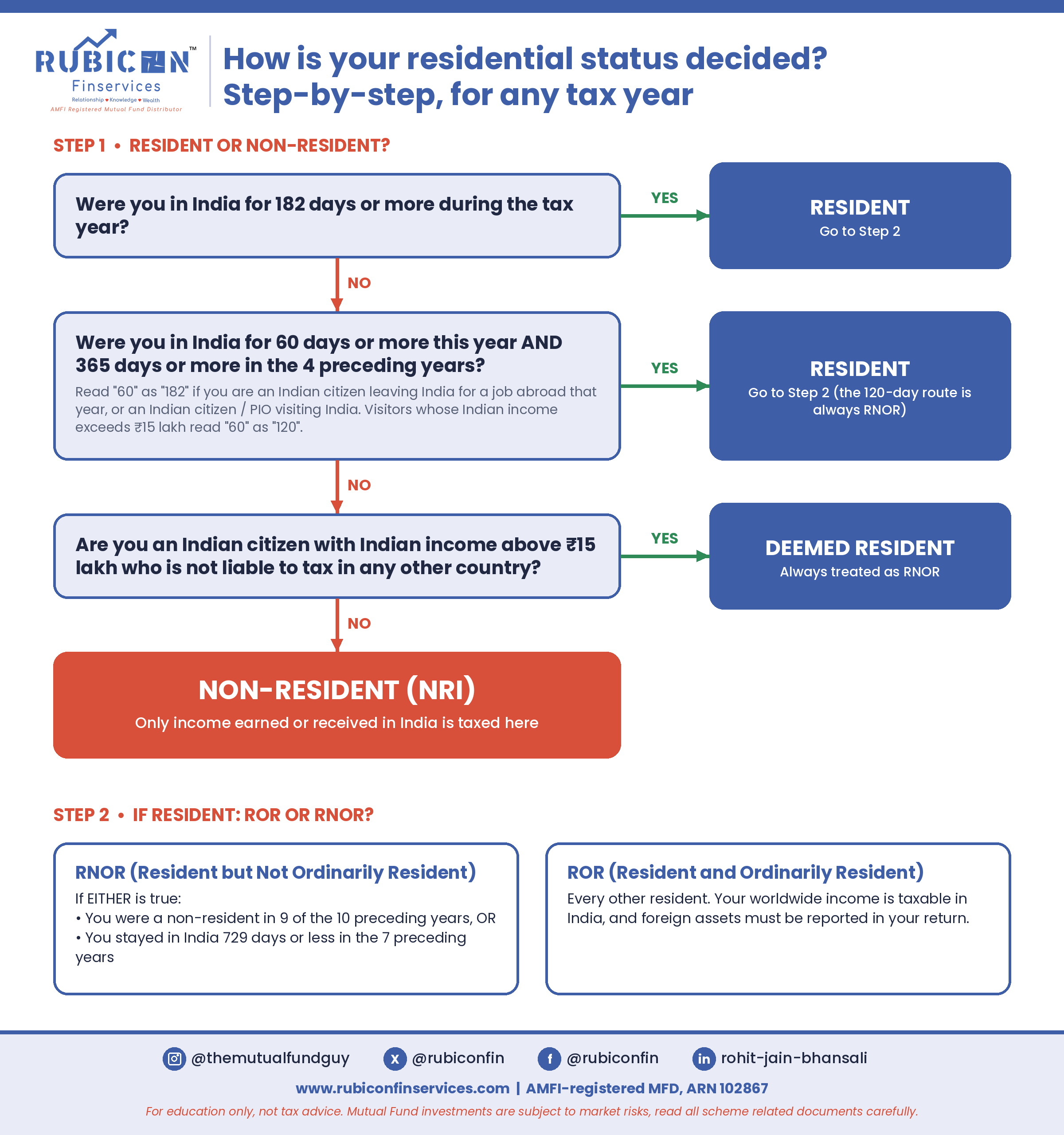
There is one more route that doesn't involve counting days at all. An Indian citizen whose Indian income exceeds ₹15 lakh and who is not liable to tax in any other country (because of residence or domicile) is deemed resident in India. This targets people who live in no-tax jurisdictions or keep moving so they are taxed nowhere. A deemed resident is always RNOR, so their foreign income still stays outside the Indian net.
For NRIs living in the Gulf or other countries without personal income tax, this is worth a careful look if Indian rent, interest and capital gains together cross ₹15 lakh.
Step 2: If resident, are you ROR or RNOR?
A resident individual is RNOR if either of these is true:
- They were a non-resident in 9 out of the 10 preceding tax years, or
- They spent 729 days or less in India during the 7 preceding tax years
Otherwise, they are ROR. As noted above, people who become resident through the 120-day rule or deemed residency are RNOR automatically.
What does your status mean for tax?
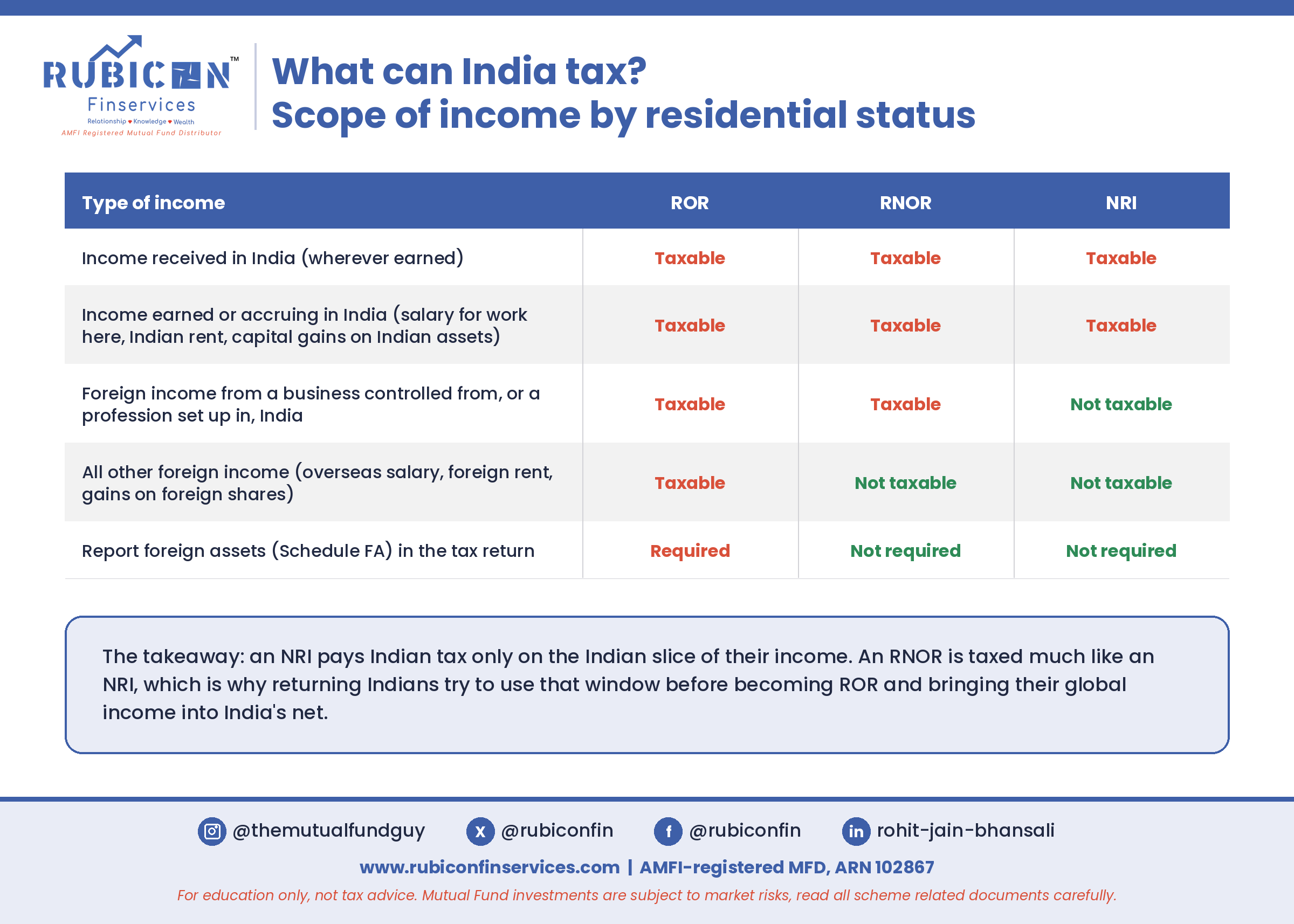
In short:
- An ROR is taxed on everything, Indian and foreign, and must report foreign bank accounts, shares, property and other assets in Schedule FA of the return.
- An RNOR is taxed on Indian income, plus foreign income only if it comes from a business controlled from India or a profession set up in India. Foreign salary, overseas interest and gains on foreign shares stay outside Indian tax.
- An NRI is taxed only on income that is received in India or earned in India. Salary earned for work done abroad and credited to an overseas account is not taxable in India, even if it is later sent home.
One point people often miss: income received in India is taxable for everyone. If an NRI's foreign salary is paid directly into an Indian account, that can pull it into Indian tax. Salary earned abroad should be received abroad first.
How NRIs are taxed in India
Slab rates
NRIs pay tax at the same slab rates as residents. The new tax regime is the default, and it can be opted out of in favour of the old regime.
The important difference is the rebate. Residents under the new regime pay no tax on total income up to ₹12 lakh because of the rebate. NRIs are not eligible for this rebate, so an NRI with, say, ₹8 lakh of Indian rental and interest income will owe tax that a resident with the same income would not.
NRIs also don't get the higher basic exemption meant for resident senior citizens under the old regime.
Tax rates and TDS on common NRI income
A few things stand out:
- Mutual funds and shares: equity-oriented mutual funds and listed shares get the same rates as residents: 12.5% on long-term gains above ₹1.25 lakh a year, and 20% on short-term gains. Debt funds bought on or after 1 April 2023 are taxed at slab rates regardless of holding period. The difference for NRIs is that the fund house deducts TDS at redemption itself, so part of the proceeds is held back before the money reaches your account.
- Property: long-term gains are taxed at 12.5% without indexation. But the buyer must deduct TDS, often on the entire sale price, not just the gain. An NRI can apply to the tax officer for a lower or nil TDS certificate based on the actual gain, and it is usually worth doing before the sale. Also, the option of paying 20% with indexation on property bought before 23 July 2024 is available only to resident individuals and HUFs, not NRIs.
- Good news on property sales: under Budget 2026, individual and HUF buyers can deposit TDS on a purchase from an NRI using their PAN, instead of obtaining a TAN, from 1 October 2026. This removes a major hurdle that used to delay registrations. The TDS rates themselves have not changed.
- Bank deposits: interest on NRE and FCNR(B) deposits is tax-free while you are an NRI. Interest on NRO accounts is taxable, with TDS at 30% plus surcharge and cess.
- Bank deposits: If more TDS was deducted than your actual liability, the only way to get it back is to file your return and claim the refund.
Using the tax treaty (DTAA)
India has tax treaties (DTAAs) with more than 90 countries. These can lower the TDS rate on dividends and interest, and they prevent the same income from being taxed fully in both countries. To use a treaty rate, you typically need a Tax Residency Certificate (TRC) from your country of residence and Form 10F, given to the payer (bank, fund house, company).
Do NRIs need to file a return?
Yes, if Indian income exceeds the basic exemption limit, or if you want to claim a refund of excess TDS, or carry forward capital losses. NRIs file ITR-2 (or ITR-3 if they have business income in India), and cannot use the simpler ITR-1.
Returning to India? Plan around the RNOR window
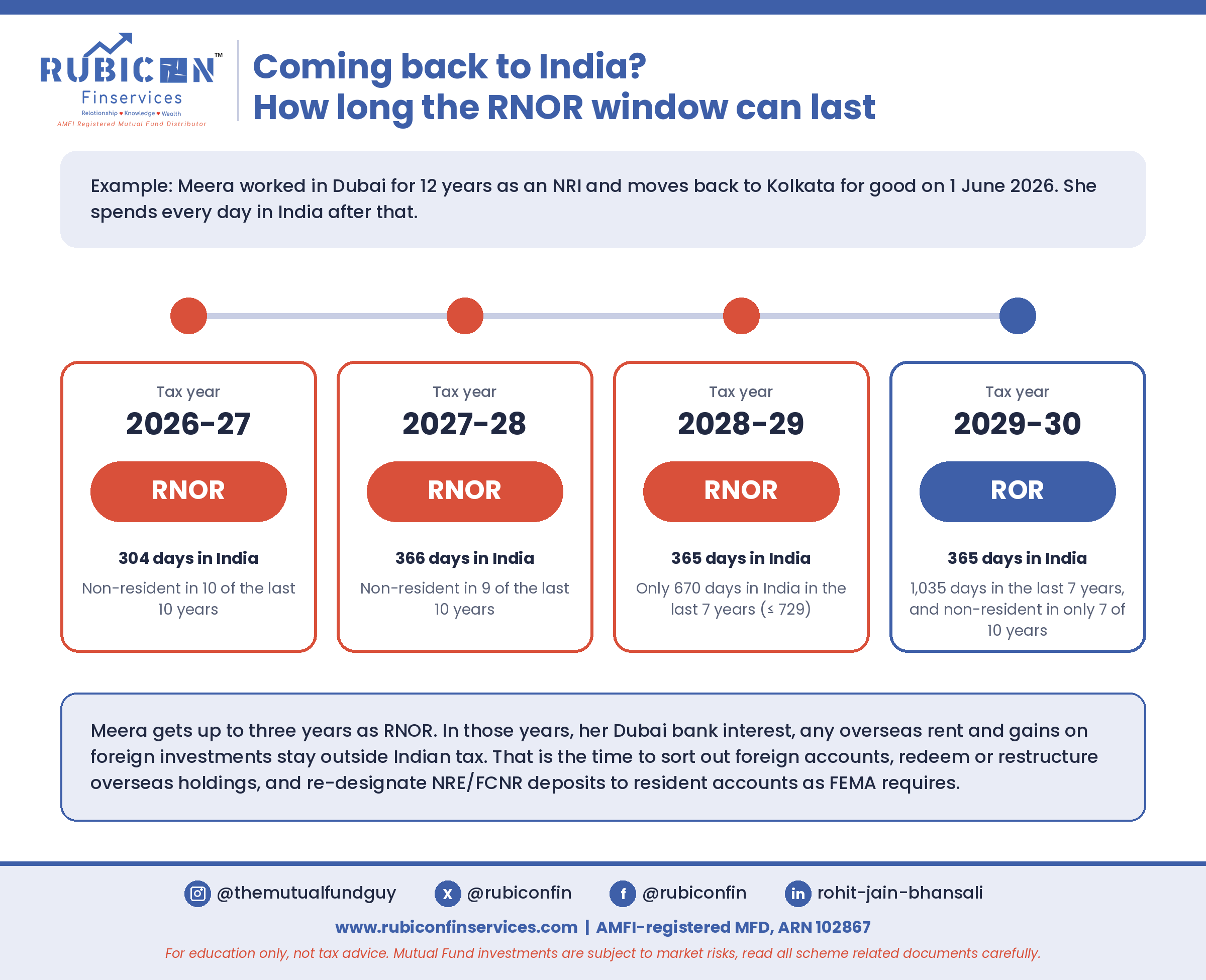
For someone moving back after many years abroad, RNOR status is a genuine planning opportunity. Most returning NRIs get two to three years as RNOR, during which foreign income stays outside Indian tax.
Use these years to:
- Decide what to do with foreign bank accounts, retirement accounts and investments, while their income is not yet taxed in India.
- Redesignate NRE and FCNR deposits to resident accounts (or RFC accounts for foreign currency), as FEMA rules require once you return for good.
- Get your paperwork ready for the year you become ROR, when every foreign asset must be disclosed in the return.
Income-tax residency and FEMA residency are not the same
This trips up many families. Income-tax status depends on day counts in a tax year. FEMA status, which governs your bank accounts and investments, depends on your intention: someone who leaves India for a job abroad becomes a "person resident outside India" under FEMA from the day they leave, even if they are still resident for income tax that year.
In practice this means that when a family member moves abroad, their bank accounts and investments need to be updated right away, not at the end of the tax year.
What this means for your mutual fund investments
- Update your status in KYC and in every folio when you move abroad. Investments made as a resident can continue, but the folio must be changed to NRI status with an overseas address.
- Link an NRE or NRO account. SIPs cannot keep running from a resident savings account after you become an NRI. Investments from an NRE account are fully repatriable; those from an NRO account are repatriable within the RBI's annual limits.
- US and Canada residents: because of FATCA and related compliance rules, not every fund house accepts investments from NRIs based in these countries, and some require a physical declaration. Check before you invest.
- When you return, change the status back to resident and update the bank mandate to a resident account.
The bottom line
Residential status is the starting point of every NRI tax question. Count your days carefully each year, keep an eye on the ₹15 lakh Indian income mark, and remember that the rules for tax, FEMA and your investments move on different clocks. If you are planning a move abroad or back home, a little planning at the start of the year can save a great deal of tax and paperwork later.
If you or someone in your family is an NRI and wants help with setting up or updating mutual fund investments, we're happy to help.
Rohit Jain Bhansali,Founder,Rubicon Finservices
rjb@rubiconfinservices.com
ARN 102867 | Initial Registration 09-June-2015 | Valid till 01-07-2027 | SIF Valid till 15-03-2029 | APRN Valid till 17-10-2027 | APMI: APMI-APRN01145 | MSME: UDYAM-WB-14-0192124 | Grievance Officer: Prem Prakash Bhansali, complaints@rubiconfinservices.com
Mutual Fund and Specialised Investment Fund investments are subject to market risks; read all scheme and investment strategy related documents carefully before investing. SIF investments carry higher risk, including the use of derivatives and short positions, and require a minimum investment of ₹10 lakh per PAN. Past performance is not indicative of future returns. Rubicon Finservices is an AMFI-registered Mutual Fund Distributor and receives commission from Asset Management Companies for the schemes and strategies it distributes. This article is for investor education only and is not investment advice or a recommendation of any specific scheme or strategy. Figures in the illustrations are indicative.