
The Nifty has now fallen for seven weeks in a row, and Monday's sell-off hit almost every sector. This post explains what is driving the fall, what history says about big market falls, and why SIP investors should stay the course.
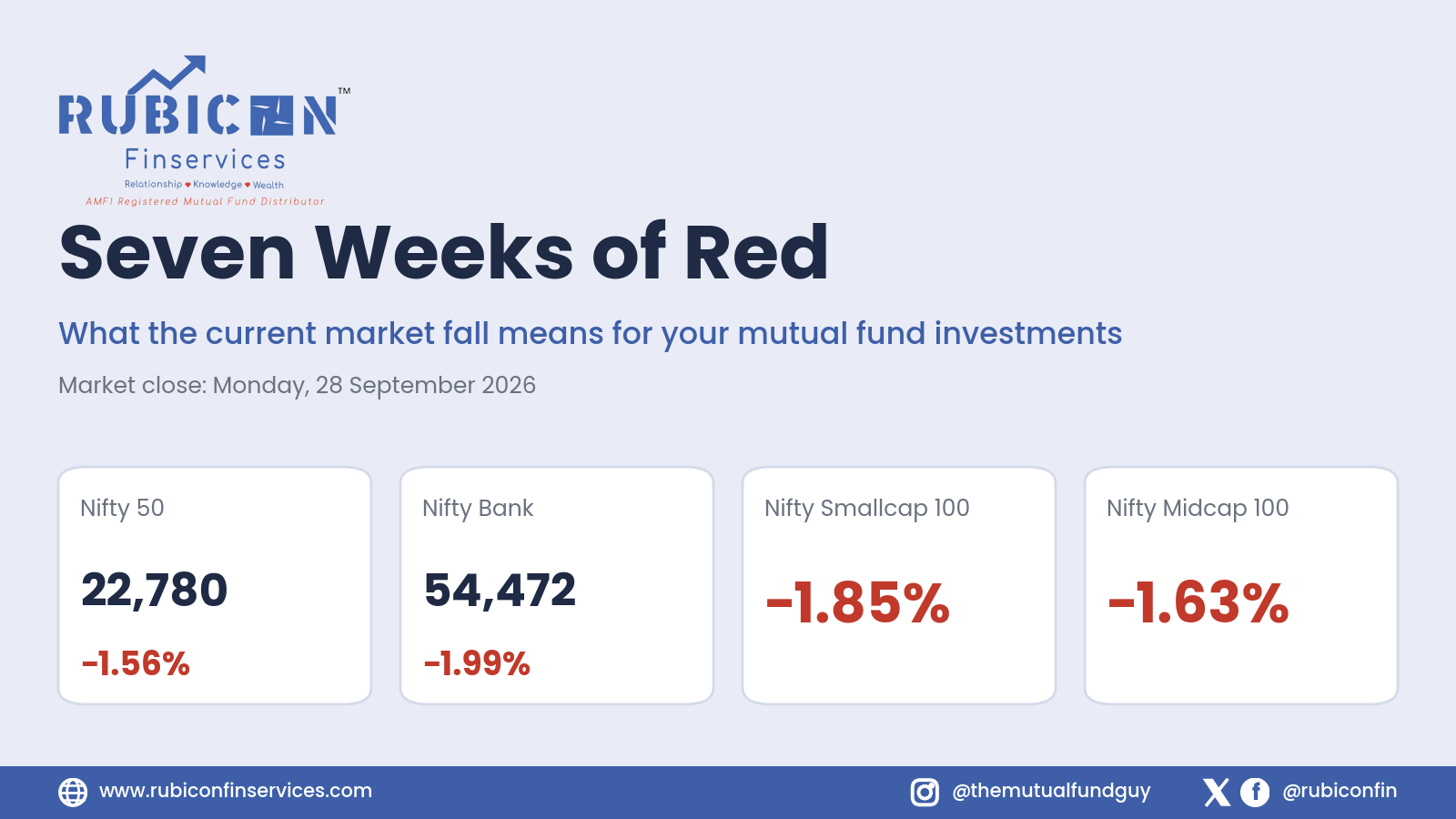
If you open MINT tomorrow morning, you will see red across your portfolio. Monday's fall will show up in your mutual fund values once the day's NAVs are updated overnight. The Nifty 50 closed at 22,780.25, down 360 points or 1.56%, and the Nifty Bank index fell 1.99%. This came right after the Nifty recorded its seventh straight week of losses.
When you see those numbers, the natural question is: should I stop my SIP, or pull money out until things settle? Before I answer that, let's look at what actually happened and why.
What happened today?
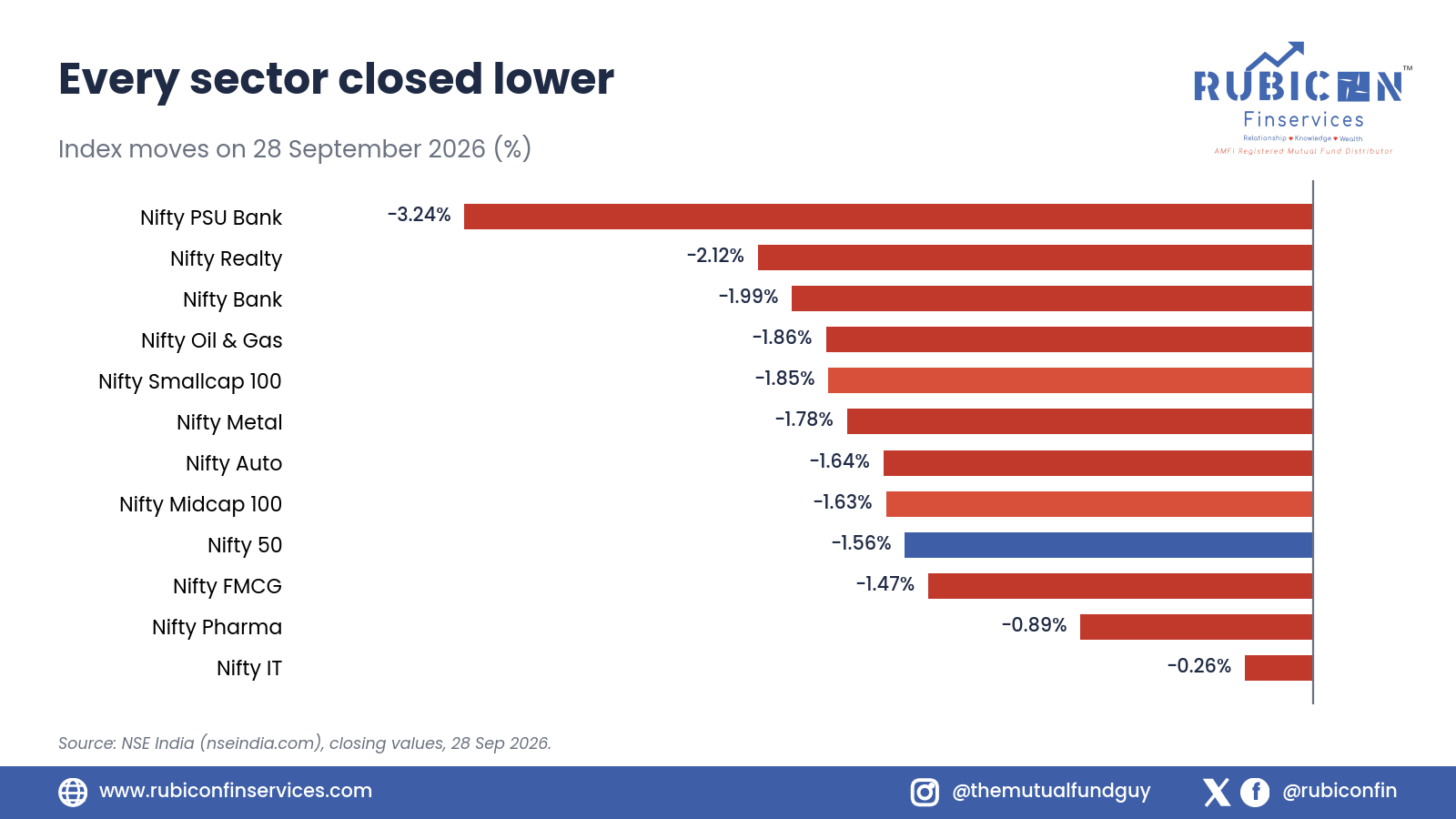
This was not a fall limited to a few heavyweight stocks. The selling was broad and touched almost every corner of the market.
Every sectoral index on the NSE closed lower. PSU Banks were hit hardest, with the Nifty PSU Bank index down 3.24%, followed by Realty (−2.12%), Oil & Gas (−1.86%) and Metal (−1.78%). Mid-caps and small-caps fell more than the Nifty, with the Nifty Midcap 100 down 1.63% and the Nifty Smallcap 100 down 1.85%. Defensive sectors held up better but still ended in the red, with Pharma down 0.89% and IT down just 0.26%.
Why the market is falling?
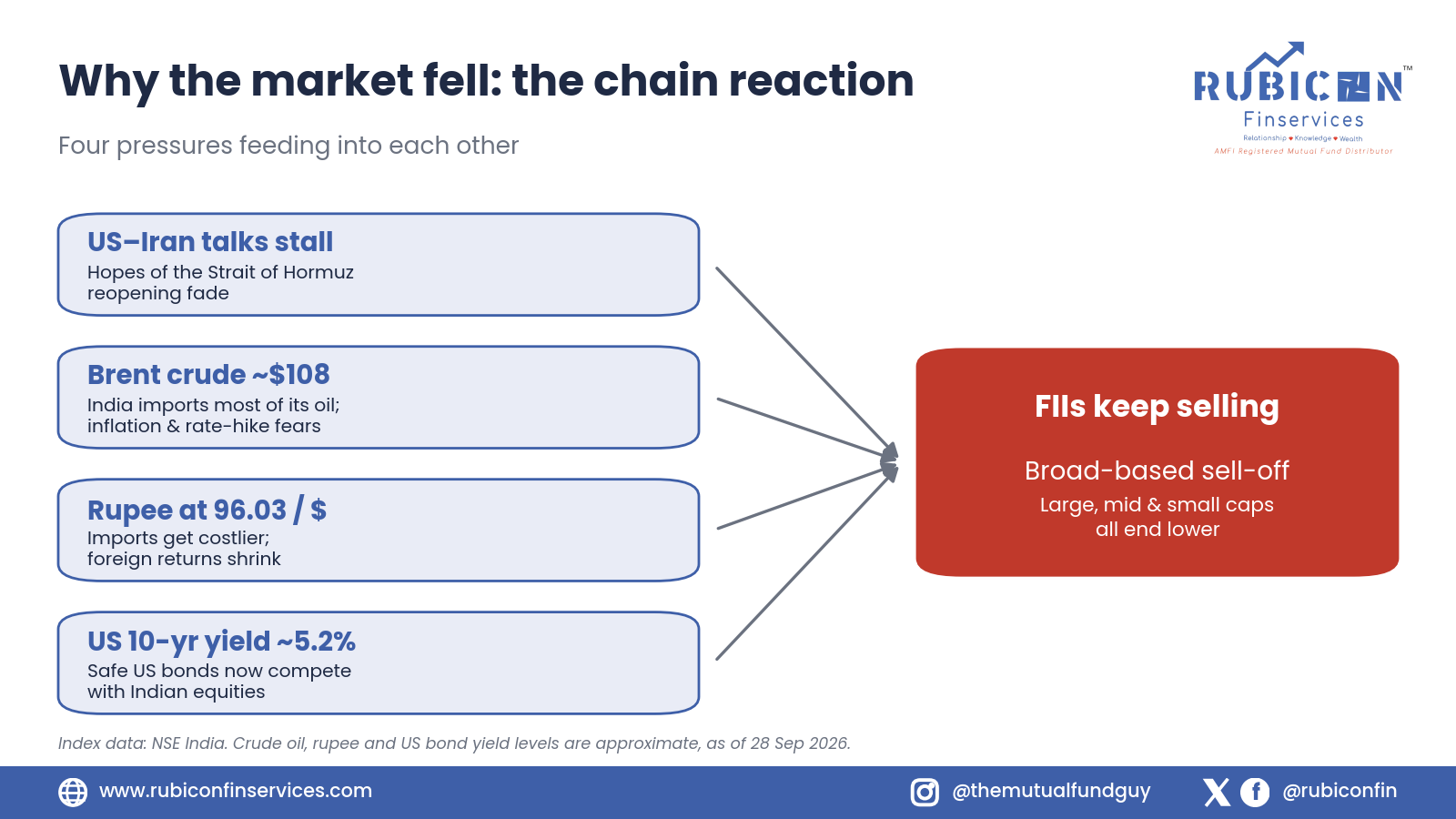
There isn't one single reason. Four pressures are feeding into each other.
- Crude oil- Hopes of a US–Iran deal to reopen the Strait of Hormuz faded over the weekend, and Brent crude jumped more than 3% to around $108 a barrel. India imports most of the oil it uses, so higher crude means higher inflation, a bigger import bill and pressure on company margins. It also raises the chance of interest rates staying higher for longer.
- The rupee- The rupee slipped 28 paise to close at 96.03 against the dollar. A weaker rupee makes our oil imports even costlier, and it reduces the returns foreign investors earn when they convert their gains back into dollars.
- US bond yields- This is the part most people miss. The US 10-year government bond is now yielding around 5.2%. When a foreign investor can earn over 5% from a practically risk-free US bond, Indian equities have to work much harder to attract that money.
- Foreign selling Put the three together and you get the result: foreign portfolio investors (FPIs) have been steady sellers of Indian stocks through September. Domestic institutions, including mutual funds backed by your SIPs, have been buying and cushioning the fall, but they cannot fully offset it.
None of these factors is about Indian companies suddenly doing badly. They are external pressures, and external pressures tend to change, sometimes quickly. A credible breakthrough in US–Iran talks, for example, could bring crude down and reverse much of this sentiment.
What history says about big falls
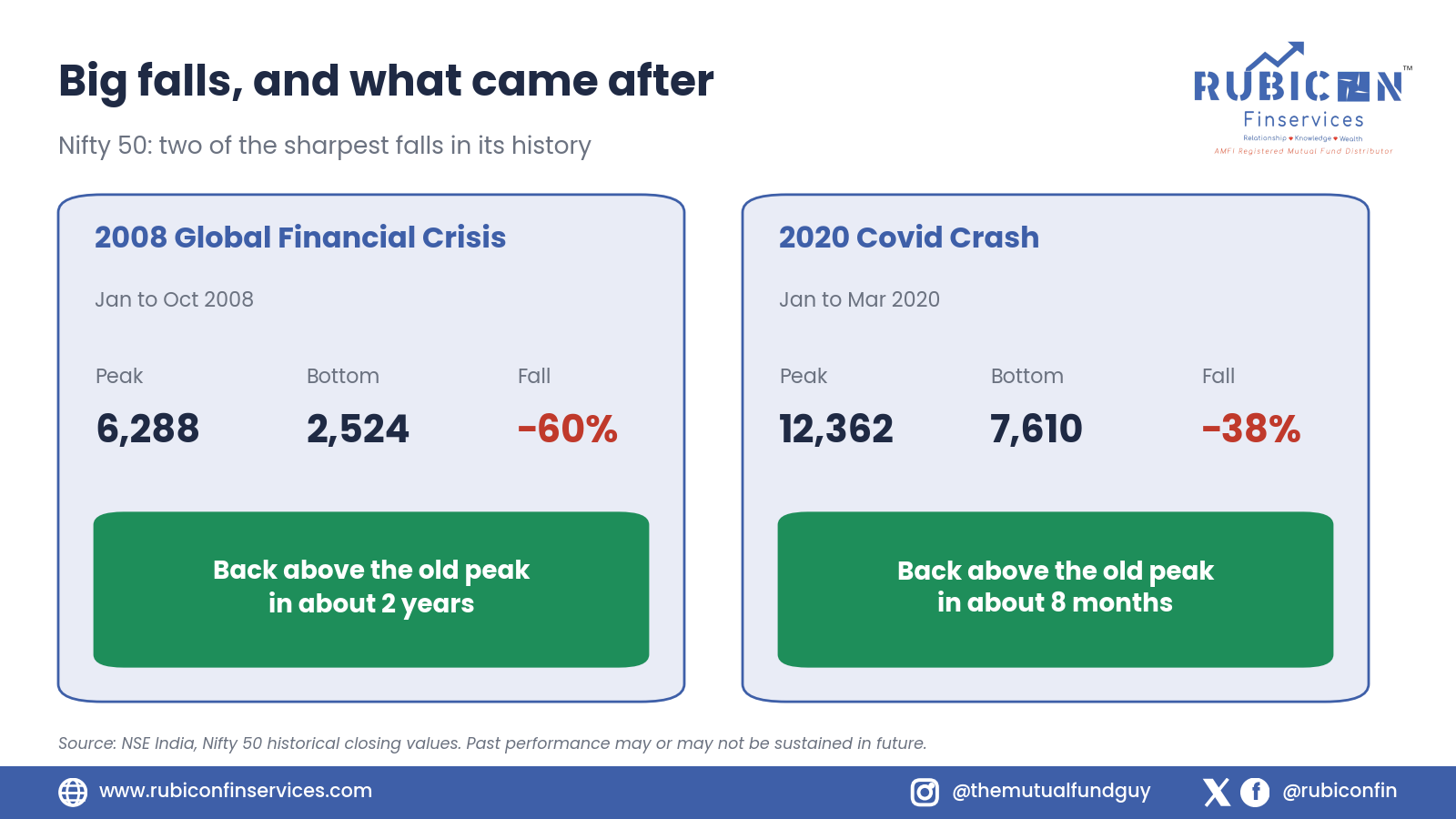
The Nifty has been through far deeper falls than this one. Two stand out.
In the 2008 global financial crisis, the Nifty 50 fell from a closing high of about 6,288 in January to about 2,524 by October, a drop of roughly 60%. It took about two years to climb back above its old peak.
In the 2020 Covid crash, the Nifty fell from about 12,362 in January to about 7,610 in March, a drop of roughly 38%, in just a couple of months. This time the recovery was much quicker, and the index was back above its old peak in about eight months.
In both cases, the index roughly doubled within about a year from its lowest point. Investors who sold near the bottom locked in their losses and missed most of that rebound. Those who stayed invested, and especially those who kept their SIPs running, came out well ahead.
I'm not suggesting the current fall will play out the same way, and nobody can say where the bottom is. The point is simpler: sharp falls have been a normal part of equity investing in India, and they have not stopped the long-term trend.
What this means for your SIP
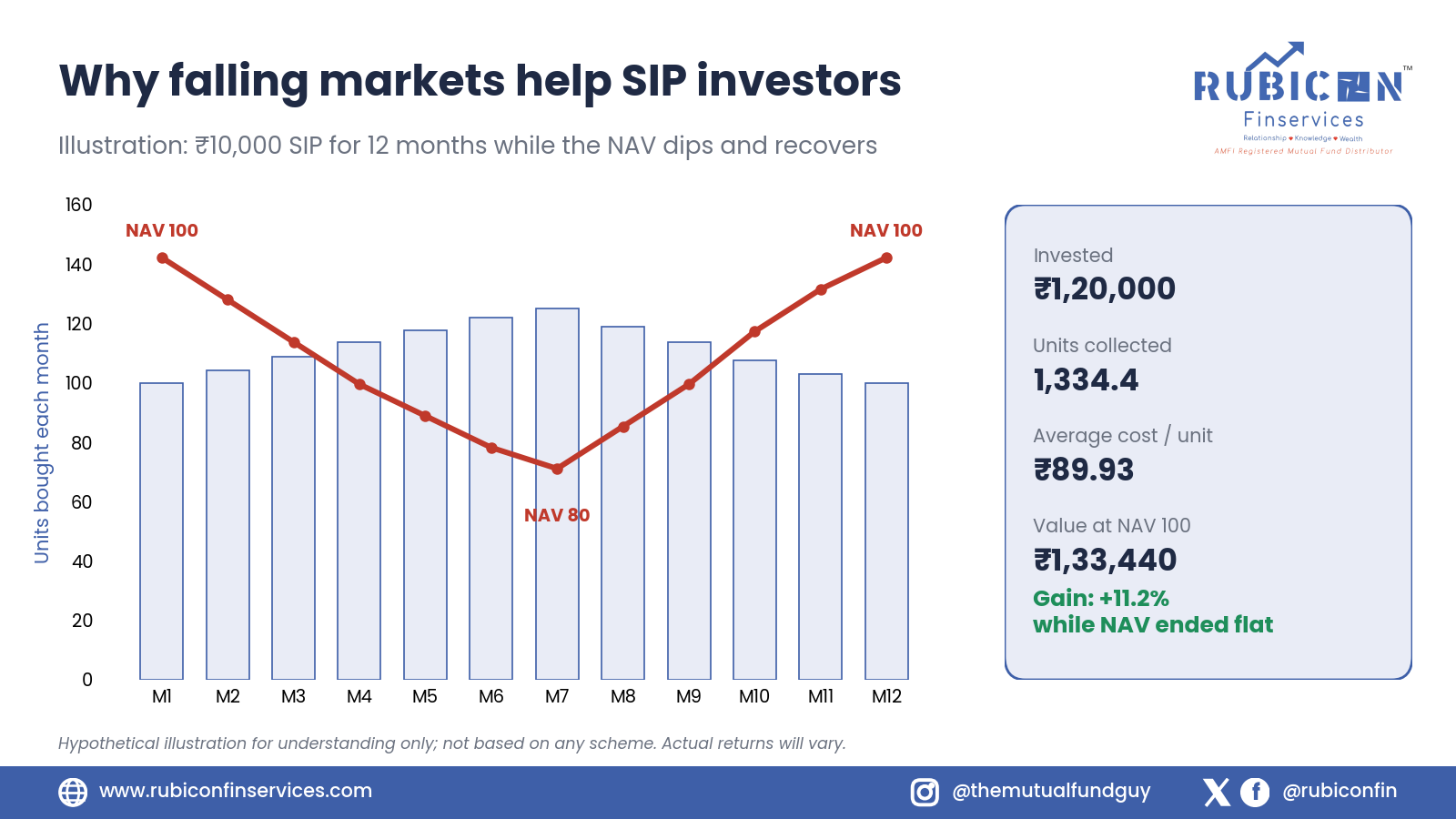
For a SIP investor, a falling market is not a problem. It is how SIPs work in your favour.
When the NAV falls, your fixed monthly amount buys more units. When markets recover, all those extra units rise in value together. This is called rupee cost averaging.
Take a simple example. Suppose you invest ₹10,000 a month for a year. The NAV starts at 100, slides to 80 over seven months, and then recovers back to 100 by month twelve. The NAV has gone nowhere. Yet your SIP has quietly collected about 1,334 units at an average cost of around ₹89.93. At a NAV of 100, those units are worth ₹1,33,440, a gain of about 11.2% on ₹1,20,000 invested.
The investor who stopped their SIP in month four, when things looked worst, would have missed buying the cheapest units of all. That is exactly the mistake a falling market tempts us to make.
What I suggest you do now
- Continue your SIPs. This is the single most important thing. Stopping a SIP during a fall means you keep the expensive units you bought at the top and skip the cheap ones.
- Don't redeem in panic. Selling now turns a temporary decline in value into a permanent loss. If the money is meant for goals five or more years away, today's prices are largely irrelevant to that goal.
- Invest lump sums in parts. If you have surplus money to invest, consider spreading it over the next few months through a Systematic Transfer Plan (STP) rather than investing it all at once. You get the benefit of lower prices without trying to predict the exact bottom.
- Check your asset allocation. f your equity share has fallen well below your target because of the correction, this may be a sensible time to top it up. If your mid and small cap exposure has grown beyond what you're comfortable with after their strong run, trim it back.
- Keep your emergency fund separate. Money you may need in the next one to two years should not be in equity at all, whatever the market is doing. If that is not in place yet, fix it first.
- Consider increasing your SIP, if you can. If your cash flows allow, a modest step-up in your SIP during weak markets has historically been one of the most rewarding decisions a long-term investor can make.
Markets have gone through far worse than this, and several sharp corrections in between. Each time, the investors who stayed invested and kept buying were the ones who benefited most from the recovery. Nobody can tell you when this fall will end. But the discipline that builds long-term wealth is the same in red weeks as in green ones. If you're unsure whether your portfolio is positioned correctly for your goals, or you'd like to review your allocation, feel free to reach out to me.
Rohit Jain Bhansali,Founder,Rubicon Finservices
rjb@rubiconfinservices.com
ARN 102867 | Initial Registration 09-June-2015 | Valid till 01-07-2027 | SIF Valid till 15-03-2029 | APRN Valid till 17-10-2027 | APMI: APMI-APRN01145 | MSME: UDYAM-WB-14-0192124 | Grievance Officer: Prem Prakash Bhansali, complaints@rubiconfinservices.com
Mutual Fund and Specialised Investment Fund investments are subject to market risks; read all scheme and investment strategy related documents carefully before investing. SIF investments carry higher risk, including the use of derivatives and short positions, and require a minimum investment of ₹10 lakh per PAN. Past performance is not indicative of future returns. Rubicon Finservices is an AMFI-registered Mutual Fund Distributor and receives commission from Asset Management Companies for the schemes and strategies it distributes. This article is for investor education only and is not investment advice or a recommendation of any specific scheme or strategy. Figures in the illustrations are indicative.